.png)

News
What is the purpose of MOGU?

Table of contents
The objective of MOGU as a product is to make available to retail and wholesale travel agencies a two-way communication channel with customers in the form of a mobile application, in order to monitor activity at the destination, provide personalized recommendations to travelers and, ultimately, make optimal business decisions based on aggregated, structured and analyzed data.
MOGU solves three major problems that characterize the travel agency sector:
- Lack of knowledge about the traveler: what are your preferences, interests, how you feel, where you are, what you need. These are questions that an agency is unable to answer with current systems. This has two negative effects: directly on sales, since when offering products or general recommendations based on variables such as popularity, it does not convert the same as if the most optimal activity is predicted given the traveler's profile. And in turn, it has an indirect negative effect on customer retention and loyalty.
- Decentralized communication: As of today, 74% of agencies use Whatsapp to communicate with their travelers, a channel that, at first glance, may sound decisive, but which in practice has serious limitations. To highlight the most relevant ones, it is not a way to make payments, schedule the sending of communications or send evaluation surveys in an agile and segmented way. To illustrate this as clearly as possible, let's look at a real example:
A tour operator (TTOO) develops a 20-day tour of Europe and distributes it through wholesalers who in turn rely on retail agencies. Finally 40 people are booking it. The guide, which reports to the TTOO, has a PDF specifying the information of each traveler and a Whatsapp group to share the information, in which there are 32 people because the rest have preferred not to be there for privacy reasons. The journey begins. The guide, on a type of trip like this, must sell the largest number of activities at the destination and usually does so through a POS, charging one by one. As you charge, you record it in a notebook. A few hours before, share information about the activities (time and meeting point) through the Whatsapp group. However, their communication is lost among the number of messages that come in later: one shares a photo, another asks if anyone has seen their child's cap on the bus, another asks about vegan menu options, etc. When the time comes, the guide is forced to resend the information. I could also have used a mailing list, however as a general communication mechanism is group travel, which ends up becoming a very inefficient process.
- Difficulty in digitizing in-house: 90% of agencies have 7-8 employees; scarce human and financial resources to lead their own digital transformation. They need third parties who are committed to the sector and provide them with technology that does not require expensive custom developments. This democratization of technology, based mainly on SaaS models, has been seen in multiple relevant sectors in a country such as fintech, healthcare, edtech and now it needs to fully reach traditional travel agency tourism.
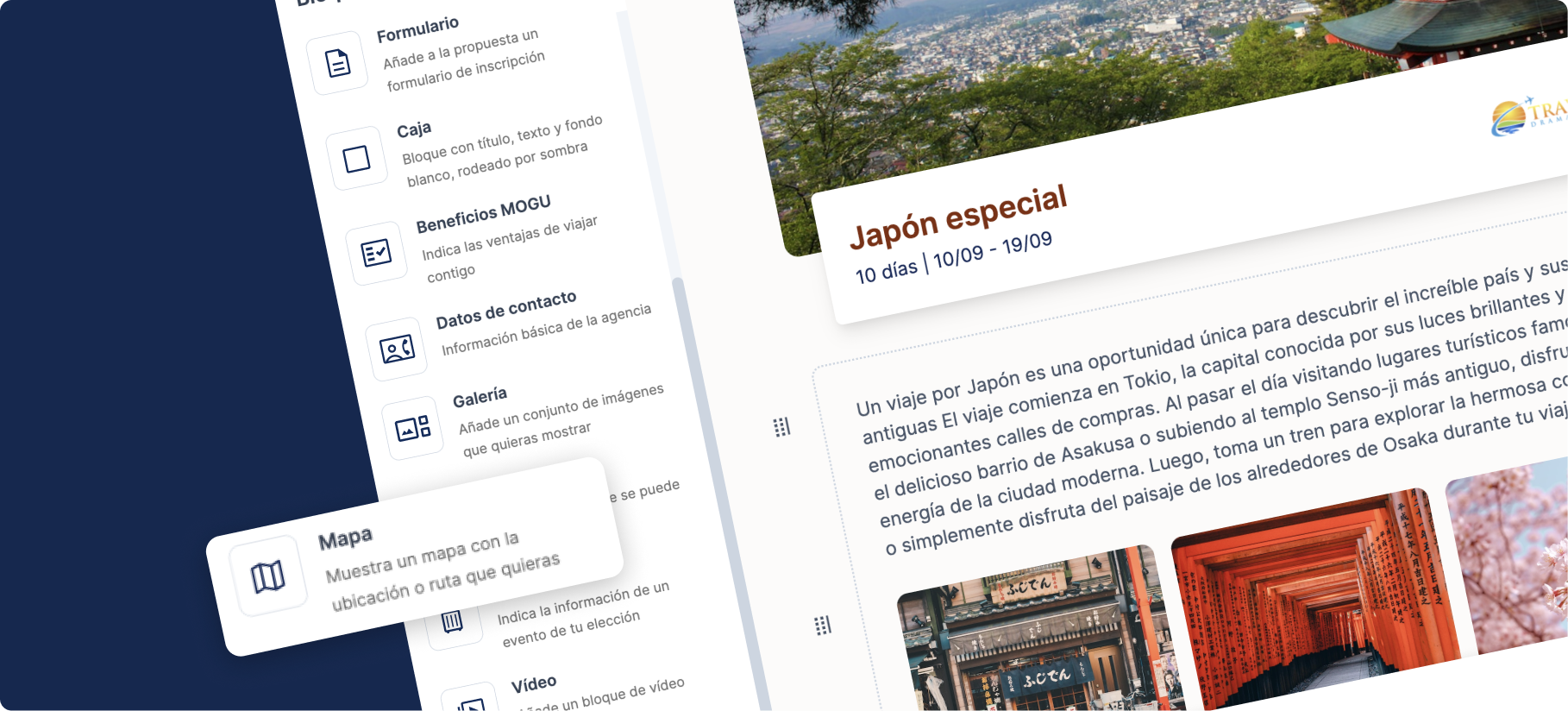
In this sense, MOGU consists of a mobile application for the agent-traveler relationship and a platform from which the agency monitors the trip in real time. The application performs two functions: on the one hand, it serves as a direct channel to centralize all the communications that take place during a trip (notifications, meeting points, practical information, messages from the guide, evaluation surveys) and on the other hand, it allows the agency to monetize the traveler at the destination since they can pay for activities from their mobile phone that MOGU automatically recommends to them in a personalized way.
As for the usage process, it is very simple: once the traveler makes the reservation (through whatever channels; there MOGU does not intervene), the agency shares the identification code of the trip to insert it in the application. From there, both parts are connected.